





The spout shape, weight and volume behind every clean latte art pour.
TL;DR: Coffee milk jugs are spouted stainless steel pitchers for steaming and pouring milk. Spout shape sets pour control: the Fellow Eddy 500ml's fluted spout suits latte art.
Coffee milk jugs are where your steam wand's work turns into a drink you can see. The spout decides how fine the stream runs, the body shape decides how the milk spins while it steams, and the volume decides how many cups you pour per steam. This range runs between the 300ml Cafelat and 1lt café jugs by Coffee Parts, Trenton and Latte Pro, with tapered latte art pitcher designs by Fellow, Pesado, iKape and Kruve alongside.
A milk steaming jug does two jobs. While you steam, its shape lets the milk roll into a whirlpool that folds air bubbles into fine microfoam. When you pour, the spout turns that texture into a stream you can steer. Start with the jug about half full: as the milk stretches it grows to around three-quarters full, so a jug that's too small overflows and one that's too big won't spin a single drink's worth of milk properly.
Stop steaming at around 60-65°C, the point where you can touch the base of the jug but can't hold it for more than a couple of seconds. James Hoffmann, in How to Make the Best Coffee at Home, notes most people's hands tolerate roughly 55°C, so the jug turning uncomfortable is your cue you're close. Scott Rao's The Professional Barista's Handbook describes steaming one tapered 20oz pitcher and sharing it between two drinks, which is why bigger jugs live behind busy café bars.
We've been supplying, servicing and repairing espresso machines since 1999. A well-tuned steam wand still needs the right jug before it shows up in the cup, which is why the jug is the first thing worth getting right. If you want sharper spouts, start with our competition pitchers.
Fill the jug about halfway with cold milk and expect it to grow to three-quarters as it stretches. A flat white is roughly 110ml of milk in a 150ml cup and a caffe latte about 180ml in a 220ml glass, so the size you need follows the drinks you make. Treat jug volumes as a guide, not a spec: two brands' 350ml jugs rarely fill to the same line.
300-360ml: one flat white, cappuccino or piccolo. A small coffee jug like the Cafelat 300ml or the Coffee Parts Classic 360ml.
400-500ml: one large latte, or a single drink with more room to spin. The Rhino Classic 450ml exists because baristas asked for a size between 12oz and 20oz.
600-700ml: two milk drinks per steam, like the Rhino 600ml Professional or the MHW-3Bomber Milk Jug 5.0 700ml.
1lt: café volume. The Coffee Parts Classic 1lt and the heavy-duty 18/10 stainless Trenton 1lt Black are built for back-to-back service.
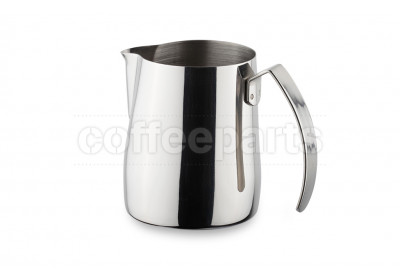
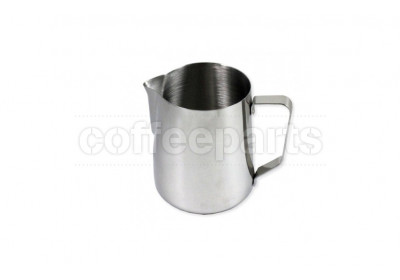
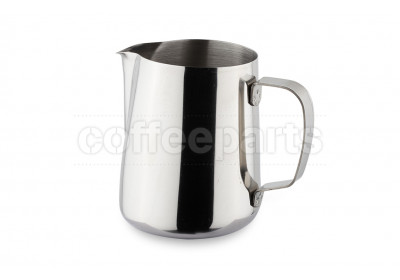
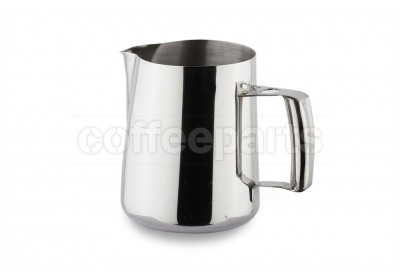
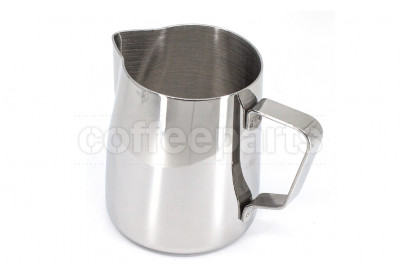
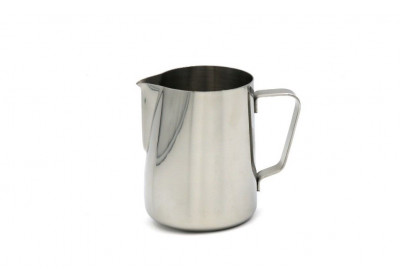
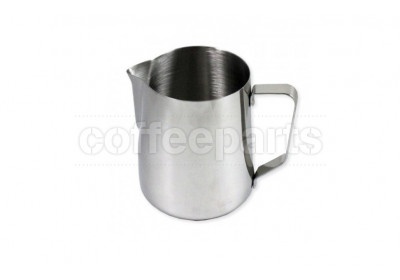
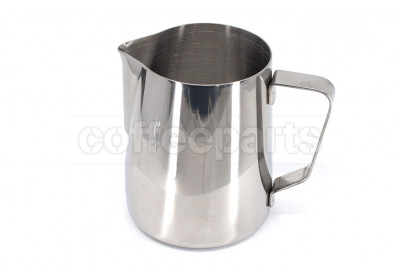
The spout is what separates a latte art milk jug from an everyday espresso milk jug. Pointed, tapered spouts narrow the stream for rosettas and tulips: the Fellow Eddy 500ml pairs a fluted spout with a sharp front crease, the iKape V2 uses a hawk spout with curved deflector grooves, and the Artisan Barista has a medium-sharp, downward-tipped spout. A smooth, rounded spout, like the Coffee Parts Classic or the Tiamo 450ml Brushed Tapered, gives a steady stream for free-poured hearts and everyday milk drinks. The Kruve Create Pitcher comes with narrow, classic and wide spouts, so you can swap as you improve. Our traditional pitchers hold the classic shapes.
Weight changes how a jug moves in your wrist. The Pesado 490ml is deliberately very light and aimed at Precision pours. The Cafelat 300ml goes the other way, with thick, mirror-finish 304 stainless walls and a rolled rim. The MHW-3Bomber GT Handless 400ml drops the handle altogether, so you hold the body directly.
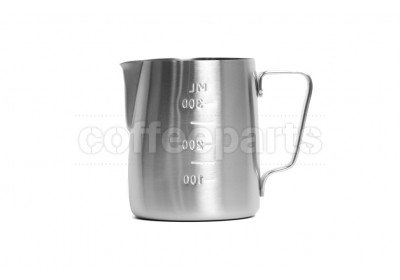
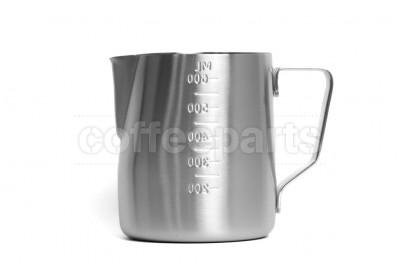
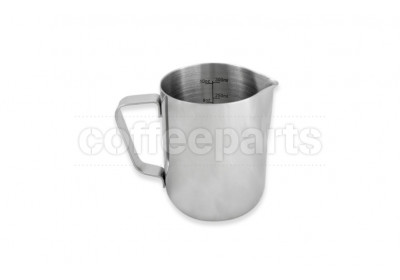
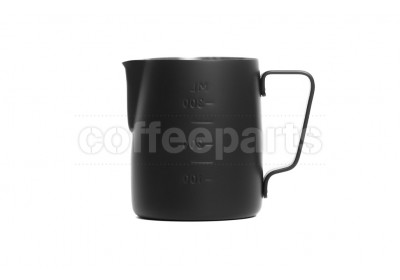
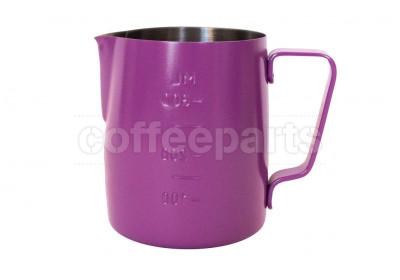
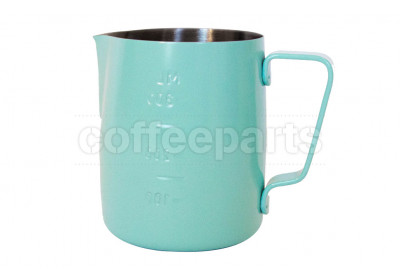
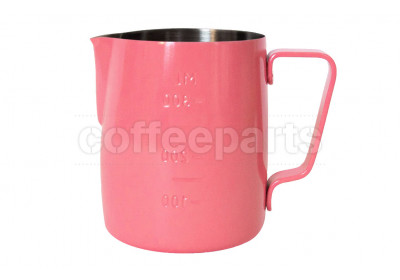
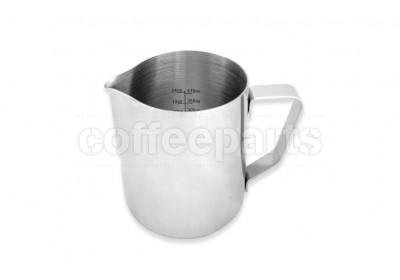
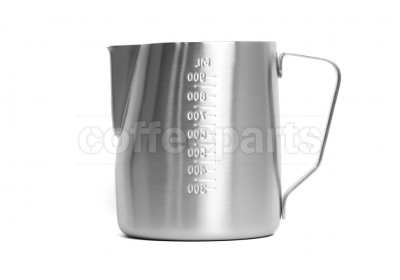
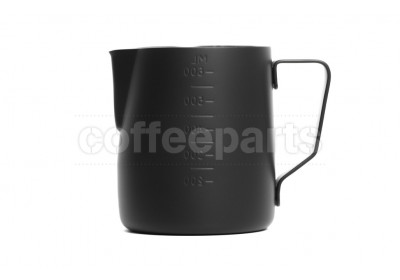
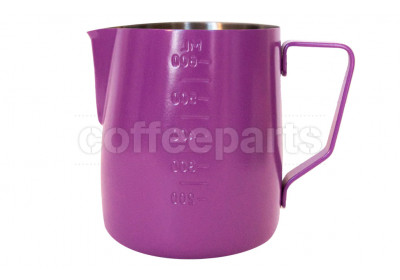
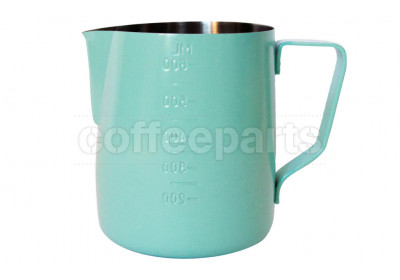
If you want a coffee jug with thermometer built in, the Latte Pro 480ml and Latte Pro 1lt have recesses on both sides for replaceable stick-on thermometers, so left- and right-handers can both read them. For measuring volume, the Rhino 600ml Professional has millilitre and ounce scales etched inside both walls, the Kruve Create has laser-engraved markings and the Fellow Eddy uses fill dots. Colour comes last: Muvna, MHW-3Bomber and Artisan Barista make multi-colour ranges, and Coffee Accessories jugs are stainless steel finished in automotive-grade paint. See the full spread in our colourful pitchers.
At home, one 350-500ml barista jug covers most single-drink mornings. Behind a café bar, keep a 600ml jug for pairs and a 1lt jug for rushes so you're not refilling mid-service.
Australia has won the World Latte Art Championship four times: Scottie Callaghan in 2006, Jack Hanna in 2007, Con Haralambopoulos in 2008 and Caleb Cha in 2015, who took the title in Gothenburg with his 'Caffeinated Zebra'. The first three came back to back. On the brand side, MHW-3Bomber was Gold Sponsor of the 2025 World Barista Championship in Milan, and Timemore was Top Sponsor of the 2025 World Brewers Cup in Jakarta. We're the exclusive distributor of both in Australia.
A jug is half the milk setup. If you'd rather not judge temperature by hand, add a digital thermometer; James Hoffmann finds digital probes work very well, while cheap dial gauges tend to be slow. A milk jug rinser clears residue between drinks on a busy bench, and our cleaning chemicals deal with milk that has dried onto stainless. Finish with cups sized to the drinks you pour, or browse the rest of our coffee machine accessories.
My advice on milk jugs is unglamorous: buy the size for your drink, not the biggest one on the shelf. An oversized jug won't spin a single flat white properly, and you'll end up blaming the steam wand for flat milk. Get the size right first, the spout right for your skill second, and the colour last. A sharper latte art pitcher narrows your margin for error; it doesn't remove it. Practice still does that part.
— Pedro Lara
If you steam with an espresso machine's steam wand, yes. The jug holds the milk while it spins into microfoam and gives you a spout to pour it. Without a steam wand, an automatic milk frother heats and textures milk on its own, though you lose most of the pour control latte art needs.
A 350-450ml jug is the usual starting point, sized for one flat white or cappuccino. You begin with the jug about half full, so a small jug keeps the volume manageable while you work on wrist control. The Tiamo 450ml Brushed Tapered and Rhino Classic 450ml sit in that band; the Pesado 490ml and Fellow Eddy 500ml sit just above it. Move to 600ml once you're steaming for two.
You'll hear milk jug, milk pitcher, steaming pitcher and frothing jug; they all mean the same spouted stainless steel vessel you steam milk in. A latte art pitcher is the same tool with a sharper, more tapered spout for detailed pours.
An automatic milk frother is the main alternative: it heats and foams milk in its own jug, with no steam wand needed. You'll get microfoam for a flat white, but not the fine pour control a pitcher gives you for latte art.
About 350ml, which is why the same jug can be sold as 12oz in one place and 350ml in another. It's the classic single-drink size; the Coffee Parts Classic 360ml, Trenton Classic 360ml and Crema Pro 360ml all sit right on it.
It helps while you're learning to stop steaming at around 60-65°C. The Latte Pro 480ml and 1lt take replaceable stick-on thermometers in recesses on both sides, so either hand can read them, and Latte Pro designed them that way to reduce cross-contamination risk. Once your hand reads temperature reliably, a plain jug does the same job.